Building a Website using WordPress

Recently I volunteered to help my riding club update their website. While I have experience designing information architectures and writing content for websites, I’m not particularly HTML literate. So when I peeked behind the curtain I was appalled. Where was the content management system (CMS)? There was none. Instead you had to ftp the articles over to the site.

This is when I learned that I was truly technology challenged. The first time I tried to go onto the site and make edits I managed to ftp all the articles from the site onto my computer, leaving just an empty URL. That convinced me that there had to be a better way.

I’ve been using WordPress.com for more than a year now. In addition to this blog I also have a popular equestrian blog, Equine Ink. I like the flexibility afforded by the templates and I find the interface to be intuitive and easy to use. In addition, I could see that by using the WordPress CMS, we could make our website more of a community effort and involve more of our members.

Since the club wanted a Website rather than a blog, I turned to WordPress.org so we could use our own URL and have email addresses associated with the site. I set up hosting through GoDaddy.com, a service that makes it incredibly easy to upload WordPress templates. Given my previous experiences using an ftp client, I was skeptical, but it turned out that after downloading the templates onto my computer, the GoDaddy interface made it easy to upload and install them.

The wealth of free — and low cost — WordPress templates is amazing. Of course, many of them look like templates and it took some time to find one that met all of my requirements. Along with finding a template with the layout and fonts I liked, it was also important to me to find one that is supported by the author. In the end I selected Paalam, a theme written by Sadish Bala. It’s a very elegant design that works well with photo-intensive postings. Having access to support forums has already helped. I wanted to move the position of the title and was able to get the revised code very quickly.

I quickly found plug-ins that added functionality such as a photo gallery and used WordPress’s password protection function to safeguard a members only section of the site. For the technically challenged, this is certainly a quick and easy way to build a fully functioning site without becoming a programmer!

For comparison purposes, here’s the site that we started with:

The original site did not allow you to easily size photos for the header and was text heavy. Since all members love to see photos and videos of the hunt, I thought we would be better served by a design that enabled us to easily incorporate images.

The original site did not allow you to easily size photos for the header (so the image repeated) and was text heavy. The navigation bar was only across the top and you need to mouse over the tabs to see the sub pages. Since all members love to see photos and videos of the hunt, I thought we would be better served by a design that enabled us to easily incorporate images.

Here’s the new WordPress site:
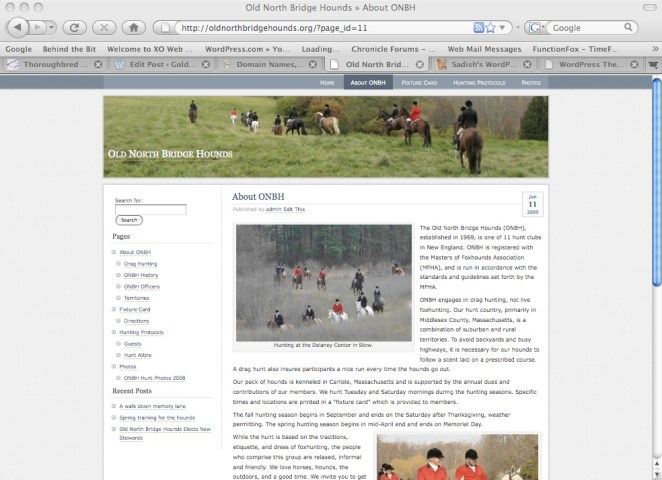
The template of the new site allows all sub-pages to be shown in the left hand navigation bar making it easier to find topics. It is easy to incorporate images into the pages and posts. I particularly like the dynamic nature of the blog format. Rather than having a static site, new posts can be easily added making the site more representative of the community.

The template of the new site allows all sub-pages to be shown in the left hand navigation bar making it easier to find topics. It is easy to incorporate images into the pages and posts. I particularly like the dynamic nature of the blog format. Rather than having a static site, new posts can be easily added making the site more representative of the community.

Do your projects have “legs”?

In this economy, the best public relations projects are the ones that can gain your company exposure in several venues. If you’re going to make an investment, it’s important that it has “legs”. In other words, that it’s something you can use more than once.

For example, if you have a subject matter expert speaking at an industry conference, you can leverage this investment in time and preparation in several ways both before and after the event:

  • Promote the presentation before the event. This helps position your speaker as an industry expert. A little extra work can reap significant rewards by making each of your efforts work more effectively.
  • After the event, turn the presentation into a Webconference or Podcast. This is a great way to reach the people who couldn’t attend the industry conference but who are interested in the topic.
  • Write an article based on the presentation and place it in an industry trade publication.
  • Use the information as the basis for a White Paper on the subject. If you post this on your Website you can harvest email addresses by requiring that people register to download the paper.
  • Feature the topic in your company newsletter (or e-newsletter) by linking to the article, Webconference archives, or White Paper.

YouTube EDU Efforts Profiled on AP

I’ve written before on the benefits that Colleges and Universities can reap from using enhanced YouTube channels to reach their target audiences. A recent AP news story gave some more insights:

College too expensive? Try YouTube

By JAKE COYLE

It might seem counterintuitive to look for higher education alongside Avril Lavigne music videos, but the video-sharing site has become a major reservoir of college content.

The Google Inc.-owned YouTube has for the last few years been forging partnerships with universities and colleges. The site recently gathered these video channels under the banner YouTube EDU (http://www.youtube.com/edu).

More than 100 schools have partnered with YouTube to make an official channel, including Stanford, MIT, Harvard, Yale and the first university to join YouTube: UC Berkeley.

There are promotional videos like campus tours, but the more interesting content is straight from the classroom or lecture hall. Many schools have posted videos of guest lecturers, introductory classes and even a full semester’s course.

At a time when many are finding college unaffordable and the ranks of the unemployed are swelling, free higher learning can sound like a good way to spend some free time.

“There’s a huge appetite around the world for people to better themselves, to study subjects that they either never got a chance to or haven’t studied in a while,” said Obadiah Greenberg, the strategic partnership manager for YouTube.

In the past five years or so, colleges and universities have been increasingly opening their doors digitally to the public.

“That Ivory Tower reputation may be even more dated than the advent of YouTube,” said Scott Stocker, director of Web communications at Stanford.

In 2002, the Massachusetts Institute of Technology launched the MIT OpenCourseWare (http://ocw.mit.edu) with the plan to make virtually all the school’s courses available for free online.

As a visitor, one almost feels like you’ve somehow sneaked through a firewall. There’s no registration and within a minute, you can be watching Prof. Walter Lewin demonstrate the physics of a pendulum by being one himself.

Last December, MIT announced that OCW had been visited by more than 50 million people worldwide. But why would institutions that charges a huge price for admission give away their primary product?

Ben Hubbard, program manager of the webcast project for the University of California, Berkeley, believes it has always been a part of a university’s vocation.

“The mission of the university has been the same since our charter days back in the 1800s,” said Hubbard. “It’s threefold: there’s teaching, research and community service. Probably in the 1800s they weren’t thinking of it as the globe, but technology has really broken down those barriers of geography.”

In 1995, Berkeley launched its webcasts (http://webcast/berkeley.edu) with video and audio webcasts of classes.

In 2007, Apple created iTunes U, a service that allows schools to make material accessible only internally by students or externally by anyone. Most schools do a little of both.

Tools like iTunes U and YouTube EDU not only benefit the community and those called “lifelong learners” curious for a lesson or two in engineering or economics. But these services are powerful marketing tools that ultimately only provide one dimension of the college experience, schools say.

“We all see that the real value in a college education goes so far beyond the lectures that faculty give,” said Stocker. “It’s a way for people to get a taste of what the Stanford experience is, but you’re not getting a degree and you’re not getting direct interaction with faculty.”

Is Public Relations in a Golden Age?

According to Larry Chase, in his latest issue of of Larry Chase’s Web Digest for Marketers, Internet marketing is giving Public Relations an additional boost.

PR packs new punch online.

The Internet has brought a golden age to Public Relations. Pre-Internet, there were bottlenecks between those who wanted to reach an audience with news and the target audience.

You had a fixed number of newspapers, magazines, radio and TV outlets, networks, etc. But, with millions of people using Yahoo News, Google News, RSS feeds, blogs, email newsletters and the like, press releases have a new, reinvigorated life online.

If you send a newsworthy press release, you can reach the end user, news outlets and the blogosphere all at once.

But, wait: It gets better. You can track the success of that press release. You can see how many Tweets, blog mentions or pickups by syndicated RSS feeds it collects.

Press releases enjoy a new life because they are (when done right) content-driven. People turn to the Internet for commercial as well as editorial content. Display ads don’t convey as much information as a press release.

I certainly agree with much of what he said. However, I don’t think that the advantages provided by the Internet stop at press releases. In fact the ability to reach your customers and prospects directly through Websites, forums and blogs provides a level of access previously unparalleled.

How much should this project cost? This is almost funny.

Last week I put a project out to bid on Guru.com. It’s a pretty straightforward project: my client wants to clean up and enhance a Zen Cart site.

I’ve looked at the CMS and figured it was maybe 20 hours of work. I solicited bids only from companies with experience in Zen Cart and I provided each company that expressed interest a very detailed list of what needed to be done.

I got bids in almost immediately. I had to stop and scratch my head. They ranged from $450 to $3,600. That’s right, the same project.

I sent back questions to two of the companies that had the highest bids. I was genuinely curious. What was it about the project that they thought would require an investment of $3,600?

From the first company, I received an estimate of the time that would be involved with specific line items. So, they really think that it would take:

  • 12 hours to set up the Zen Cart site for a company based in Massachusetts. I’m sorry, but having looked at the Admin panel, I know that it’s a question of changing one setting. Actual time? 15 minutes to find the right setting and click on the right box.
  • 20 hours to test the site in multiple browser/operating system configurations. Really? We’re talking about a site that’s got fewer than 10 pages. Maybe they know about more configurations than I do!
  • 8 hours to test that the shopping cart functionality works. I guess that’s not included in the above mentioned 20 hours of browser testing! Let’s see, I tried it myself. In less than half an hour I found out that the cart does work. Phew, saved myself 7.5 hours!
  • 12 hours to resize two images on two pages. Are they planning to redraw them? Heck, we paid less than that for the designer to create the images!
  • 16 hours to complete text edits on the FAQ page. That’s about 25-cents per word. Most writers don’t make that much.

Okay, you get the picture now. The bid was so over the top that it was funny. Except that it isn’t. In my mind it’s a case of a company that is trying to take advantage of what they perceive to be a client’s ignorance. Pricing on this level is extortion.

The second company in this price range said only that it was expensive because the request was “so detailed.” They immediately offered to cut their price in half, but only if I awarded the bid to them that day. Sorry, I don’t work with suppliers that try to gouge me the first time.

In the end, we did most of the work internally. We did find a few programmers who provided honest bids but I’m sorry to say that out of the 16 companies that sent me proposals, they were in the small minority. We are going to start working with one soon and hope that he is as good as his references state.

Bottom line? As a client or agency understanding the scope of the project and it’s worth is essential. There are plenty of people waiting in line to take your money who hope you just don’t know the right sum to pay.

What happened to customer service?

In this economy you’d think that anyone with a client or customer would bend over backwards to keep them. I had an experience lately that make me think that the message just isn’t sinking in. Or maybe these folks have so much work that they don’t see the need to focus on customer service.

The first case involves my father, who recently moved to an independent senior living center in Manhattan. On March 3 he wanted to change his meal plan for the month and was told that he had to wait until April because the month had started.

It took me two phone calls that day to convince them that they could — and should — make an exception if for no other reason than he is on a three-month satisfaction guaranteed lease agreement. Once they saw the explicit relationship between the meal plan and potentially losing a resident all was fixed but their knee-jerk reaction was no, it’s too much trouble.

Where’s Your Web Site Being Built? Probably not in the U.S.

I’ve long been a proponent of buying local. I like to meet with designers and programmers and feel that it has, up until now, been the best way to get a quality product.

However, I’m changing my mind. I’ve bid out several sites recently and have come to the conclusion that programming is, for the large part, programming. It doesn’t matter if it’s done in the U.S., India, or Romania as long as the functionality is there and the site is robust. I’ve bid out several projects recently and while part of me wants to use local talent, I simply cannot justify spending three to four times more on a U.S. supplier than one working overseas. In some cases the hourly rates in the U.S. are more than 10x higher. As one client said, “you could ask three of these suppliers to do the project, pick the best one and still come out ahead.”

So, where are you building your next site? As for me, I’m brushing up on my foreign language skills.

How Much Time is a Project Worth?

Whether you bill by the hour, by the project or by retainer, the bottom line for all of us as PR practitioners is that we want our clients to feel that they got value for their money; and we want to feel that we were adequately compensated for our time and expertise.

In the equation Finished Product = Time + Expertise, occasionally hiccups arise.

I ran into this frequently when I worked at a large PR firm. Someone working for me would write the ultimate press release and hand me a time sheet documenting the fact that they’d spent 17.5 hours on their masterpiece.

The problem is, at any billing rate imaginable, the time billed would far exceed the value of the press release to the client. If a client expects someone to spend approximately 4 hours on something, what do you do with the remaining 13.5?

Some of this is just youthful exuberance. You want to to “the best” job possible and you lose track of the fact that time = money. You are also desperate to fill up your time sheet so that you look productive. Over time you get a better sense for what something is worth to a client and plan your time accordingly. Sometimes, thanks to your own skill, expertise and efficiency, you are able to produce work of such great value to a client with such alacrity that your effective billing rate actually goes up! Occasionally, something takes you longer to complete than you thought, but you don’t bill the extra time because, while you still want to deliver a quality product, the client would not think the extra cost worthwhile.

The other cause for excessive time consumption is inexperience. This occurs when someone undertakes a project for which the skills are learned on the job. The trick here is to determine what the project is worth to the client before you step in the morass of potentially unbillable hours then to decide whether being paid that sum is worth it to you, given that at the end of the project you will have skills and experience that make you a better practitioner. Keep in mind that no matter  how much time you think you will need to invest in this endeavor, it will take longer than you expect.

Under no circumstances, however, should you ask for your client to pay for your learning curve.

Of course, the third situation is when a client significantly changes the scope of the project mid-stream. When that happens it is extremely important to raise a flag immediately and explain why this is outside the scope of the project and how much the change in direction will alter the budget. This is not the time to assume that the client understands that they’ll pay more, because believe me, they won’t! There have been times when clients have come to me and said they didn’t think they’d paid enough for the services provided given how much extra had been added, but those instances are few and far between.

The Power of PR in the Social Media Environment

In today’s economy, maintaining a company’s good reputation is essential.

Over the past week, I’ve watched the power of PR and social media combine to achieve results that a single person found impossible. The issue was a custom made saddle for a professional rider. The rider had ordered the saddle from a “high end” French saddle maker at a cost of $4K.

Unfortunately for her, when said saddle was delivered, it didn’t fit her horse, despite the fact that the manufacturer’s rep had measured the horse. You’d think that in the interest of customer satisfaction, the manufacturer would take the saddle back and make it work. Well, they did take it back, but when it was returned to the customer it still didn’t fit. Two years later, the company had neither fixed the saddle or given the customer a refund.

In an act of frustration, the rider posted the story on a popular equestrian bulletin board. Watching the post expand was an interesting experience. Some readers expressed their outrage at how the rider had been treated by the custom saddle manufacturer; some shared their own customer service nightmares with the same company; and many people talked about the positive experiences they’d had with competitive companies.

After 37,868 views the company finally offered the rider a settlement. But at what cost? At least 10 writers said flat out that they would now look at other manufacturers, losing the company at least $40K in sales . . . and the long-term effect of this negative publicity is incalculable.

Website for Radiology Practice Features Browser-Updatable Content

As a PR practitioner I’ve always hated working on client websites that don’t have a content management system that I can access. Yes, I know they have legal issues to contend with, but inevitably even the smallest changes take forever to implement and typos manage to creep into the copy . . . requiring yet another round of changes and additional charges.

Recently I helped a radiology practice in Springfield, Mass. create a website. One of their requirements was that the site use a content management system that allowed them to make regular updates and additions.

When I work on a website I generate the information architecture, write the copy and serve as the interface between the client, the designer and the programmer. While this was supposed to be a “down and dirty” site to get them started, it ended up being pretty comprehensive, including information about the practice and educational information about the different aspects of radiology.

The site was built using Drupal which has a very user-friendly content management system and a lot of flexibility. Even I can make the updates as it requires only a minimal knowledge of HTML.

Radiology & Imaging